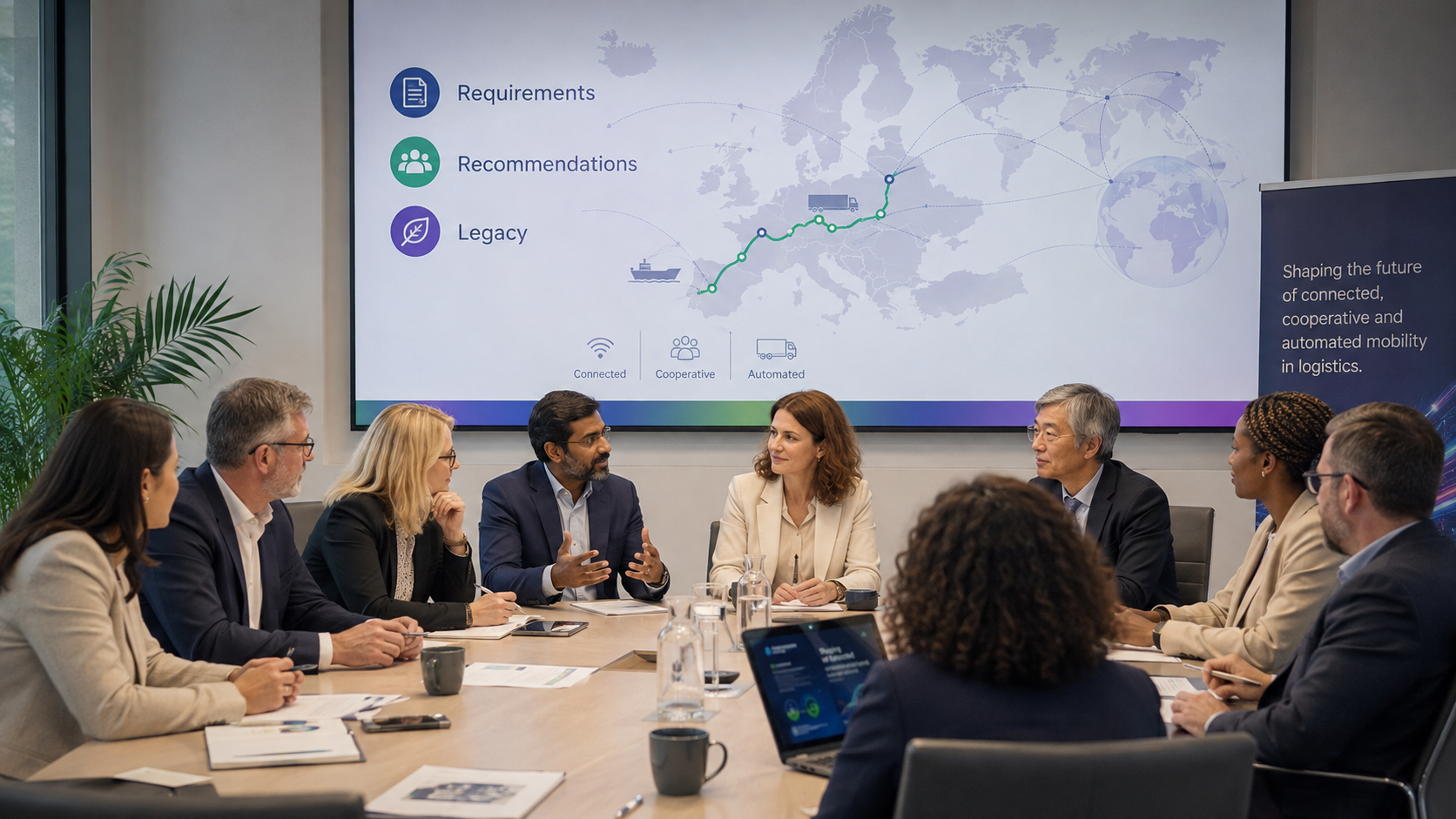
Last June MODI held its third and final Stakeholder Board Group (SBG) workshop, bringing international experts together with the consortium to review the project’s emerging results, reflect on lessons learned from its real-life demonstrations and provide external feedback on the recommendations being prepared for the future deployment of Connected, Cooperative and Automated Mobility (CCAM) in freight transport.
Organised through two online sessions to facilitate participation across different time zones, the workshop represented the final formal consultation with MODI’s Stakeholder Board Group before the project enters its concluding months. Its objective was clear: to ensure that the knowledge and recommendations generated by MODI are relevant, realistic and useful beyond the project itself, incorporating perspectives from stakeholders that will ultimately play a role in bringing automated freight transport from demonstration to wider deployment.
🌍 Bringing international expertise into MODI throughout the project
The Stakeholder Board Group has provided MODI with an external perspective throughout its lifetime, acting as a forum where experts from the CCAM and logistics communities could review, challenge and complement the work carried out by the consortium.
This dialogue has accompanied the evolution of the project. The first SBG workshop focused on the requirements for highly automated freight transport, helping MODI strengthen its attention to logistics value creation, connectivity, infrastructure and the needs of users and stakeholders. The second workshop moved closer to implementation, reviewing the project’s use cases and demonstration plans and discussing the role of C-ITS, digital infrastructure, cross-border operations and regulatory harmonisation. This third consultation brought the process full circle by focusing on results, lessons learned and recommendations for deployment.
The international dimension has remained a defining feature of the group. The latest workshop involved 16 external experts from 10 countries across four continents, covering different parts of the CCAM and logistics value chain: vehicle and technology providers, logistics operators and shippers, ports and infrastructure owners, representative organisations and international mobility experts.
Participants represented organisations including IKEA, Bosch, Port of Rotterdam, TomTom, Dynamic Map Platform from Japan, IRU, PAVE Europe, ITS Australia, Canadian Automated Vehicle Initiative and Bring Cargo International, among others. This diversity has enabled MODI to contrast its European findings with expertise and deployment experiences from Europe, North America, Asia and Australia.
💬 From real demonstrations to deployment lessons
During the two workshop sessions, MODI shared an overview of the results emerging from its demonstrations and analytical work, followed by discussions with the Stakeholder Board Group on their relevance for future deployment.
The conversation went beyond automated vehicles themselves. MODI’s demonstrations across the Rotterdam–Oslo corridor and its use cases in the Netherlands, Germany, Sweden and Norway have increasingly shown that automated freight transport needs to be considered from a system perspective.
One of the main conclusions discussed with stakeholders was that successful deployment is not simply a vehicle technology challenge. Automated vehicles need to operate as part of an integrated logistics ecosystem incorporating physical and digital infrastructure, connectivity, terminals and warehouses, logistics processes, charging, remote supervision, data exchange, regulation and operational stakeholders.
Stakeholders also reinforced several broader lessons emerging from MODI:
- System integration is essential: automation needs to connect seamlessly with the wider logistics chain rather than create new operational bottlenecks.
- Digital infrastructure is becoming as important as physical infrastructure: connectivity, interoperable data services, machine-readable information and trusted data exchange will be increasingly important for automated freight operations.
- Interoperability and harmonisation remain critical: freight transport crosses borders, meaning that infrastructure, services, standards and regulatory approaches need greater alignment across Europe.
- Business value must complement technical feasibility: the next phase of CCAM development needs to increasingly demonstrate scalability, productivity improvements and viable operational models.
- Deployment will be progressive: structured and predictable logistics environments provide strong opportunities for early deployment, while more complex public-road and cross-border operations will require continued technological, regulatory and organisational progress.
These discussions provided an important external validation of the direction taken by the project as MODI moves from demonstrating technical and operational feasibility towards consolidating its deployment recommendations and long-term legacy.
🎯 Refining MODI’s recommendations for future deployment
A central part of the workshop focused on the preliminary recommendations being developed from MODI’s technical work, demonstrations and stakeholder engagement activities.
The recommendations are being structured around five areas considered fundamental for wider CCAM freight deployment:
- physical infrastructure
- digital infrastructure
- best practices for automated freight transport
- standardisation
- regulation
Rather than looking at these elements independently, stakeholder discussions again highlighted the need for a coordinated approach. The value of automation will ultimately depend on whether vehicles, infrastructure, logistics operations, digital services, authorities and business models can evolve together.
This also reinforces an important transition identified during the workshop: future initiatives should increasingly move from proof of concept towards proof of value, demonstrating not only that automated freight solutions can operate technically, but that they can be integrated, scaled and deliver measurable benefits to logistics operators, infrastructure managers and society.
🚀 From MODI results to the next generation of CCAM initiatives
The third workshop closed an important stakeholder engagement cycle for MODI, but the exchange of knowledge with the wider CCAM community will continue beyond the project.
The evidence and experience generated through MODI can provide valuable building blocks for the next generation of European CCAM initiatives, including future large-scale demonstrations, cross-border testbeds, the European Connected and Autonomous Vehicle Alliance (ECAVA) and upcoming European research and innovation activities.
At the same time, the international composition of the Stakeholder Board Group has helped MODI maintain an open dialogue with experts working on automated mobility deployment around the world. This exchange is particularly valuable as Europe, Japan, North America, Australia and other leading regions address many of the same challenges around infrastructure readiness, interoperability, regulation, business viability and logistics integration.
As MODI enters its final months, ensuring that its results, recommendations and practical lessons are transferred to future European initiatives and the wider international CCAM community will be an important part of the project’s legacy.
The MODI consortium would like to thank all members of the Stakeholder Board Group for their engagement and valuable contributions throughout the project. Their input has helped ensure that MODI’s work remains connected to real deployment needs and to the broader objective of accelerating safer, more efficient and more sustainable automated freight transport in Europe.
📍Join Us at the MODI Final Event in Antwerp

The MODI consortium is already preparing its Final Event, which will take place in Antwerp on 15–16 September 2026, bringing together project partners, policymakers, industry representatives and the broader CCAM and logistics community.
The event will feature:
- project results and lessons learned
- discussions on deployment readiness
- networking activities
- live demonstrations during the Autonomous Summit at the Port of Antwerp-Bruges
👉 Registration is now open only by e-mail: modi@railgrup.net
Please note that, due to the limited number of seats, final confirmation of attendance will be communicated by e-mail.

Further information about the final programme and activities will be announced soon.
 Don’t miss MODI promotional video on YouTube and also available on MODI’s official website.
 Stay tuned for further updates on our ongoing initiatives as the MODI consortium continues to expand global partnerships and drive innovation in the CCAM arena. For more information about the project and its developments, please join our Newsletter, and keep following MODI on LinkedIn and X (Twitter).