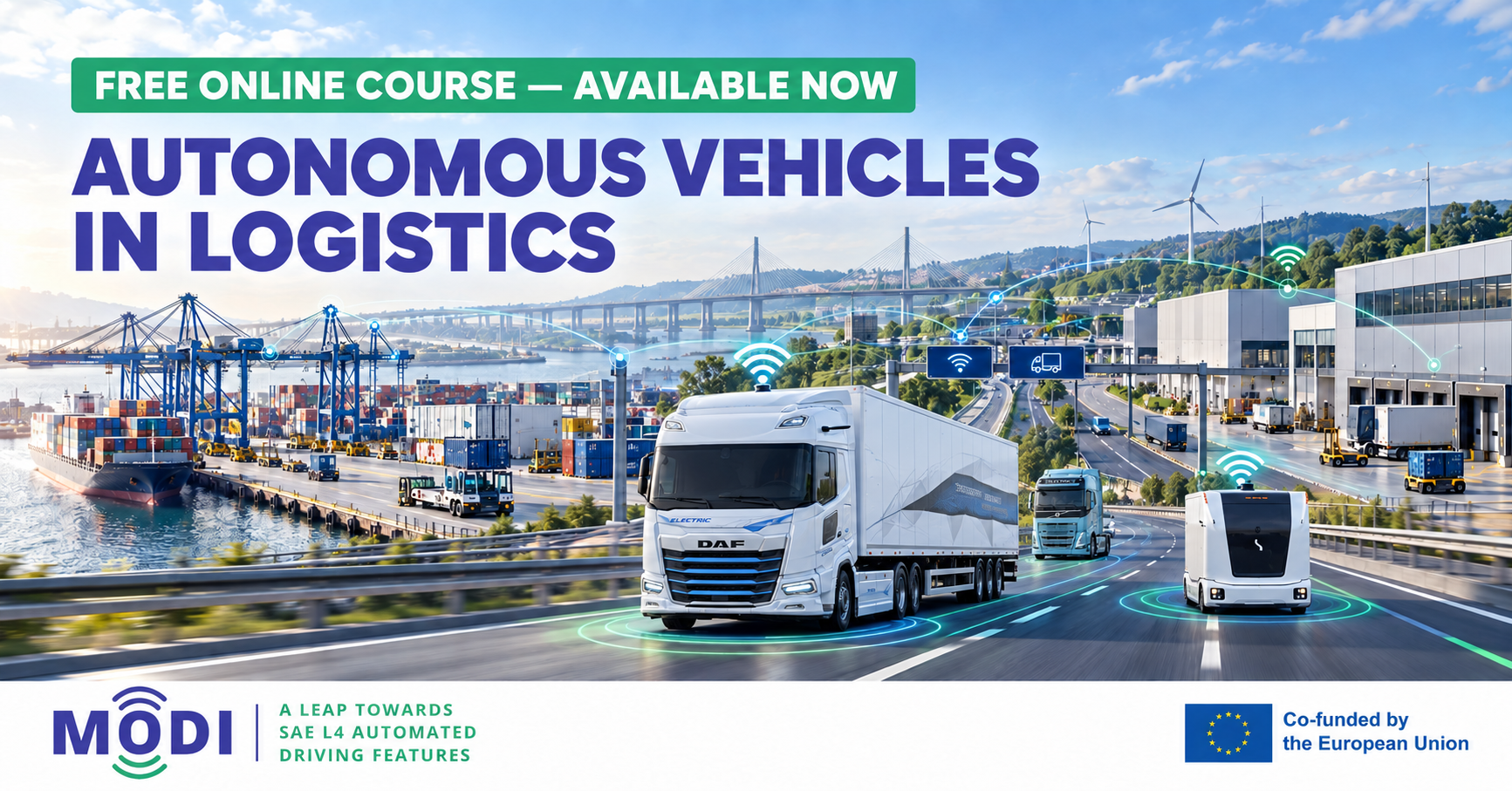
As MODI moves from project implementation towards the uptake and long-term use of its results, we are pleased to make one of its key educational resources available to the wider transport and logistics community: the free Massive Open Online Course (MOOC) on Autonomous Vehicles in Logistics.
The course was originally developed through the European 5G-Blueprint project and has now been extended and updated within MODI by the Supply Chain Innovation research group at HZ University of Applied Sciences.
Its purpose is to transform the knowledge generated by MODI into an accessible, user-friendly and scalable learning resource—helping logistics and transport professionals, researchers, lecturers and students understand the opportunities, challenges and practical requirements associated with automated transport.
Bringing MODI’s findings to Europe’s logistics talent
Connected, Cooperative and Automated Mobility (CCAM) has the potential to improve the safety, efficiency and resilience of logistics operations, while helping the sector respond to challenges such as driver shortages and the increasing complexity of supply chains.
However, accelerating deployment requires more than technological development. Europe also needs professionals who understand how automated vehicles interact with logistics processes, infrastructure, connectivity, regulations, business models and other actors across the transport ecosystem.
The MOOC helps address this need by bringing MODI’s findings directly to Europe’s current and future logistics talent. By translating project results into a structured online learning experience, the course supports knowledge transfer, professional development and the uptake of MODI’s innovations in further research and real logistics operations.
What does the course cover?
The course provides an introduction to the main concepts, technologies and applications associated with autonomous transport. It combines expert-led videos, presentations, assignments, background information and recommended reading.
The programme is structured around four modules:
- Introduction to Autonomous Systems
An overview of autonomous transport, its main characteristics, potential advantages and limitations, and the broader issues influencing its introduction. - Technology
An introduction to the technologies that enable automated mobility, including localisation, perception, prediction, route planning, connectivity and vehicle control. - Teleoperation
An exploration of the remote operation of vehicles and machinery, including its application to road transport and logistics and its role as an intermediate step towards higher levels of automation. - Applications in Logistics
A new module developed within MODI to transfer the project’s results and lessons from its real-world logistics demonstrations.
A dedicated module presenting the MODI use cases
Module 4 is specifically designed to share the outcomes of the MODI project. It combines demonstration videos, presentations summarising the results of each use case, supporting materials derived from MODI deliverables, recommended articles from the MODI library and a final knowledge quiz.
Participants will explore the five MODI application areas:
- Port operations – the Netherlands: Automated vehicles integrated into existing logistics operations at a port site.
- Motorway-to-harbour – Germany: Automated vehicles approaching and transitioning into a confined harbour environment.
- Hub-to-hub transport – Sweden: Automated heavy-duty transport between logistics hubs.
- Border-to-port operations – Norway: Automated freight transport from an international border crossing to a port.
- The MODI CCAM corridor: The wider conditions required to enable automated freight transport along the European corridor from Rotterdam to Oslo.
Through these cases, participants can learn directly from MODI’s demonstrations and better understand how vehicle technology, logistics operations, physical and digital infrastructure, connectivity, regulation and cooperation between stakeholders must come together to enable CCAM deployment.
Flexible, practical and accessible learning
The MOOC has been designed primarily for logistics and transport practitioners, while remaining accessible to a broader audience, including:
- Logistics and terminal operators
- Transport authorities and infrastructure managers
- Automotive, technology and mobility professionals
- Researchers and research organisations
- Students and lecturers in logistics, transport, mobility and supply-chain-related disciplines
- Anyone interested in the practical application of autonomous vehicles in logistics
The course can be completed entirely online and at each participant’s own pace. The estimated workload for the full programme is approximately 20–25 hours.
Each module concludes with a multiple-choice quiz. Participants can also obtain a certificate upon completion of the course, provided that they complete all modules and submit the required assignments.
Extending the legacy of MODI
The completion of MODI does not mark the end of the project’s contribution to European automated logistics. Ensuring that its knowledge, evidence and practical lessons remain accessible—and can be used by professionals, students, researchers and future European initiatives—is a central part of the project’s legacy.
This MOOC is one of the resources through which MODI will continue supporting education, knowledge transfer, further research and the responsible deployment of CCAM solutions in logistics.
The MODI Library will serve as the main access point for downloading and consulting the project’s key results, including videos, presentations, publications, public deliverables and other practical resources. The MODI website will remain available for at least three years after the project’s completion, allowing the CCAM and logistics communities to continue benefiting from, applying and building upon its results.
Over the coming weeks, we will continue presenting further MODI results, tools and findings through our website and social media channels. Our objective is to make these resources easy to discover, use and take forward across the European mobility and logistics ecosystem.
Register for free
Interested in learning from MODI and expanding your knowledge of autonomous transport and its applications in logistics?
➡️ Register for the free course at mooc.hz.nl
Start learning at your own pace and discover how automated and teleoperated transport can contribute to safer, more efficient and more resilient European logistics.
 Don’t miss MODI promotional video on YouTube and also available on MODI’s official website.
 Stay tuned for further updates on our ongoing initiatives towards MODI’s legacy. For more information about the project and its developments, please keep following MODI on LinkedIn and X (Twitter).