
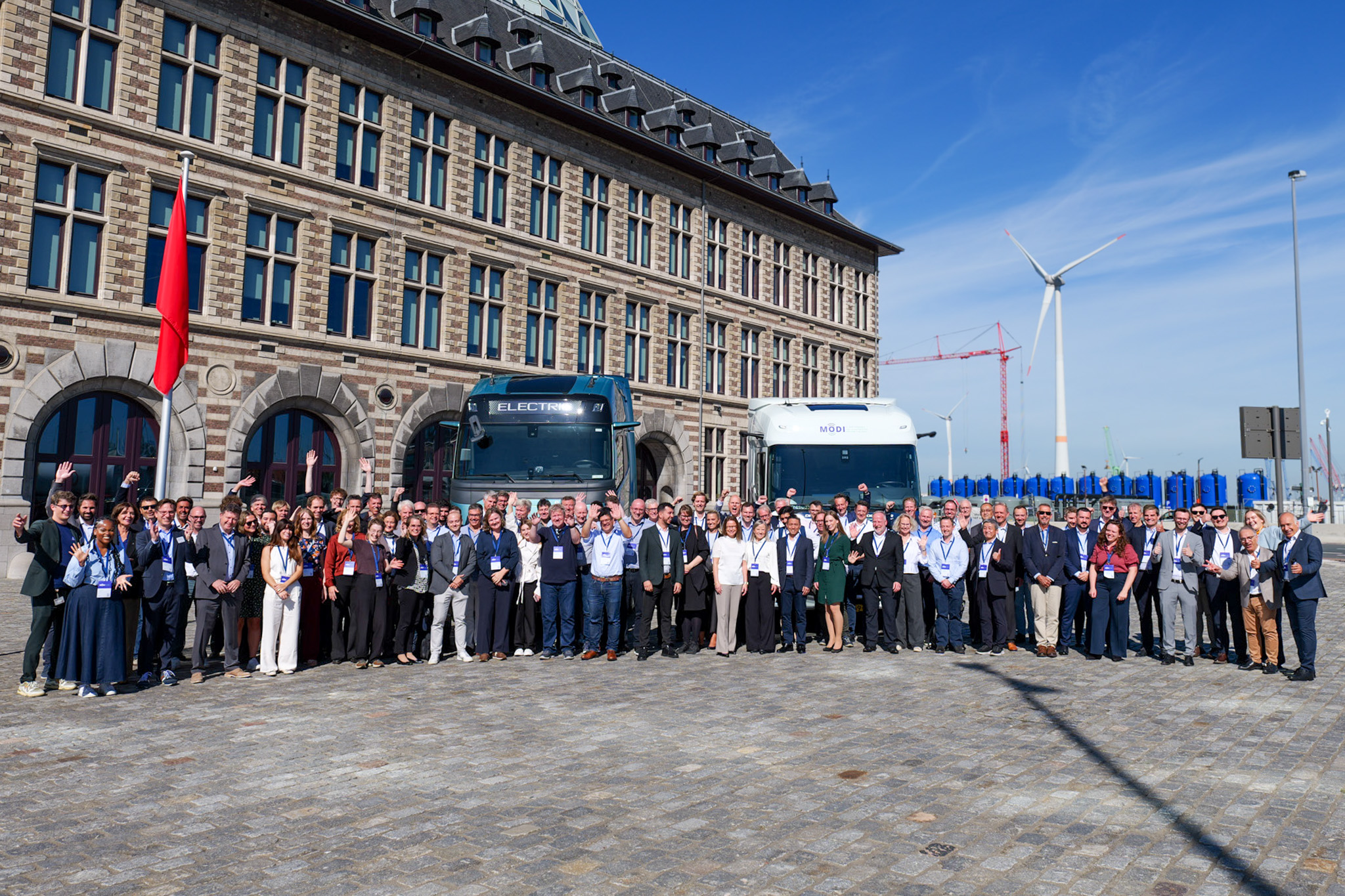
On 15 September 2026, more than 100 participants gathered at the iconic Port House of the Port of Antwerp-Bruges for the MODI Final Event. Bringing together logistics operators, vehicle manufacturers, technology providers, researchers and public authorities, the event marked the culmination of four years of collaborative work to accelerate the deployment of Connected, Cooperative and Automated Mobility (CCAM) in European logistics.
A full-day programme combined project results, industry discussions and European policy perspectives, complemented by use case stands, static demonstrations featuring Volvo and DAF trucks, and videos of MODI demonstrations, including those involving Einride. A livestream also enabled the wider community to follow the conference.
The event provided an opportunity to reflect on what MODI has achieved and what its experience means for the next phase of automated freight transport. Across the sessions, one message connected the technical findings with the wider discussion: successful deployment requires vehicles, infrastructure, logistics processes and regulatory frameworks to work together.
Setting the Scene: Why Europe Needs Automated Freight
Dr. Ragnhild Wahl and Dr. Lone-Eirin Lervåg of ITS Norway opened the event, welcoming participants and introducing the project’s contribution to European freight automation.
In his opening keynote, Fernando Liesa, Secretary General of ALICE, placed MODI within the challenges facing the logistics sector. Driver shortages, pressure on operational performance and international competition are strengthening the need for automation that responds to real market requirements. His presentation emphasised the importance of starting with use cases where safety, operational feasibility and commercial value can align, creating a foundation for further investment and deployment.
Andrea De Candido of the European Commission’s DG Research and Innovation brought the European research and policy perspective, connecting the experience of projects such as MODI with the ambition to advance towards large-scale CCAM demonstrations and market uptake.
The project overview then brought participants through MODI’s demonstration environments: port operations and drayage in the Netherlands, motorway-to-harbour operations in Germany, hub-to-hub transport in Sweden, and border-to-port operations in Norway. These activities were complemented by the assessment of infrastructure readiness along the Rotterdam–Oslo corridor.
Together, they have enabled MODI to investigate how automated freight vehicles interact with terminals, warehouses, public roads and cross-border procedures, generating evidence on the conditions required for their integration into everyday logistics.
From Demonstrations to Evidence: MODI’s Key Results
The morning’s main technical session, moderated by Lone-Eirin Lervåg, explored the findings from operating SAE Level 4 freight vehicles and the implications for wider deployment.
Vehicle validation and regulatory approval were addressed by Urban Dagerhorn of AstaZero. His presentation explained how MODI combined virtual and physical testing to reproduce operational environments, assess risks and build confidence before demonstrations. The experience highlighted the need for clear descriptions of operating conditions, repeatable validation methods and greater harmonisation of safety assessments and approval procedures across Europe.
Business and operational findings, presented by Ross Phillips of the Institute of Transport Economics (TØI), showed how the value of automation depends on its integration into the logistics chain. Predictable transport flows, productive vehicle use and effective coordination with loading, charging and terminal activities are central to viable business models. MODI’s analysis demonstrated why vehicle purchase costs alone cannot determine the business case: utilisation, workforce productivity and the organisation of the overall operation can be decisive.
The potential impacts of automated freight were examined by Hanne Seter of SINTEF. The findings identified reduced worker exposure during activities such as automated loading and unloading as an important near-term safety benefit. Environmental performance also depends on the overall system, including driving behaviour, operational design and the energy consumed by automation equipment. The assessment reinforced the importance of evaluating benefits in their operational context.
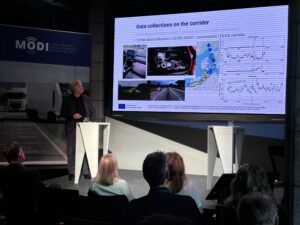
Infrastructure readiness, presented by Petter Arnesen of SINTEF, drew on data collection and analysis along the MODI corridor. The findings indicated that initial deployment can build substantially on existing roads, supported by targeted improvements. Reliable connectivity, positioning, digital maps and machine-readable road information remain essential, particularly where services must continue across borders. Addressing gaps in reliability and interoperability is therefore a priority for scaling.
Finally, Martin Thelen of BASt presented the MODI Book of Recommendations, consolidating the project’s lessons into 90 recommendations across five themes: physical infrastructure, digital infrastructure, integration of L4 vehicles into logistics, standardisation and regulation. Developed with project partners and prioritised with stakeholder input, the work includes 30 recommendation cards for 13 stakeholder groups, translating the findings into guidance for those responsible for implementation.
Bringing the Demonstrations into the Event
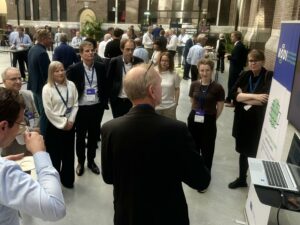
Throughout the day, participants could explore the use case stands, meet the teams behind the demonstrations and discuss the practical work underpinning the presentations.
Outside the Port House, the Volvo and DAF trucks provided a visible connection to the vehicles involved in MODI’s research and demonstration activities. Demonstration videos, including those featuring Einride, brought further operational settings into the conference, illustrating the project’s work across different logistics environments.
These exchanges created space for detailed questions about vehicle capabilities, infrastructure requirements and the changes needed when introducing automation into existing operations. They also connected the findings presented on stage with the experience of the partners who developed, tested and integrated the solutions.
Industry and Public Authorities Reflect on the Lessons
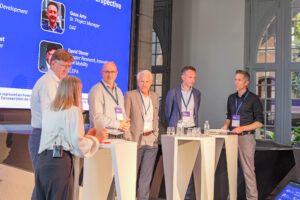
The afternoon began with reflections moderated by Ragnhild Wahl of ITS Norway and Bastiaan Krosse of TNO, bringing together the perspectives of the organisations that will develop, operate and enable automated freight services.
Jop Spoelstra of Technolution presented lessons from system integration, including MODI’s work on coordination interfaces and collaborative fleet and traffic management. These contributions illustrated the importance of reliable information exchange between vehicles, infrastructure and logistics systems.
Dedicated panels brought together the logistics perspective, with GRUBER Logistics, Gothenburg RoRo Terminal and Einride; the automotive perspective, with Einride, Volvo, DAF and CLEPA; and the public-sector perspective, with New Mobility Solutions Hamburg, the Norwegian Mapping Authority and the Swedish Transport Administration.
The discussions examined the project’s learnings from complementary positions across the ecosystem, connecting operational requirements and industrial development with the responsibilities of public authorities and infrastructure managers.
The educational dimension also formed part of the programme. Jakolien van der Meer of HZ University of Applied Sciences presented how MODI’s demonstrations and expert knowledge have been translated into learning materials for students, teachers and professionals through the MOOC on Autonomous Vehicles in Logistics. This provides a practical route for bringing the project’s experience into professional development and education.
Connecting MODI’s Legacy with Europe’s Deployment Agenda
The final part of the programme focused on how MODI’s results can contribute to the next generation of European initiatives.
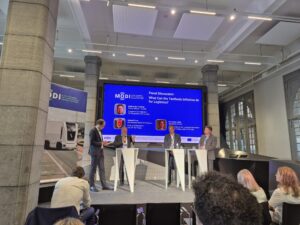
In the legacy session moderated by Angjelo Andoni of ALICE, representatives from DFDS, APM Terminals, Procter & Gamble and the Port of Antwerp-Bruges explored how the project’s experience can inform further logistics automation. Their perspectives connected the findings with the needs of transport operators, terminals, cargo owners and ports.
Stephane Dreher of ERTICO then presented the deployment building blocks being developed through CCAMbassador. Covering vehicles, infrastructure, operations, business, regulation and people, this work provides a broader framework for identifying the actions and responsibilities needed to advance deployment. It also offers a channel for bringing freight-specific evidence into discussions associated with the European Connected and Autonomous Vehicle Alliance (ECAVA).
The session on large-scale cross-border testbeds brought the European Commission and stakeholders together to consider how these environments can support logistics. Contributions from DG MOVE, DG Research and Innovation, the City of Hamburg and ALICE connected the testbeds initiative with practical requirements such as coordinated permitting, interoperability and learning across countries.
MODI’s experience is directly relevant to these priorities. Its corridor assessment, validation work and recommendations provide evidence that future initiatives can use when designing operations across organisational and national boundaries.
Closing contributions from the CCAM Association and Aria Etemad of Volkswagen, presenting Pre-LSDemo, placed this experience within Europe’s wider progression towards large-scale demonstrations. The discussion underlined the value of carrying forward reusable results and addressing deployment conditions alongside continued technological development.
Five Lessons to Carry Forward
The conclusions presented by MODI provide a clear framework for the work ahead:
- Feasibility: L4 freight transport works within defined operational conditions. Understanding and validating those conditions is fundamental to deployment.
- Integration: The interfaces between vehicles, infrastructure and logistics operations are a central deployment challenge.
- Readiness: Deployment readiness depends on the whole ecosystem, including its organisations, services and regulatory arrangements.
- Value: The business case comes from improving logistics performance, through better coordination, utilisation and operational reliability.
- Scale: Early deployment should focus on applications where automation creates value, with interoperability designed in from the outset.
These lessons give future projects, industry and public authorities a shared basis for deciding where to act and what must mature as automated freight services expand.
Keeping MODI’s Knowledge Available to the Community
The Final Event celebrated the collective effort behind four years of research, development and demonstrations, while establishing a foundation for the continued use of the project’s results.
The MODI Library will serve as the main access point for the project’s public results, including videos, presentations, publications, deliverables and other resources. The website will remain available for at least three years after the project’s completion, complemented by access through CORDIS and relevant open-access repositories, helping the CCAM and logistics communities discover, reuse and build upon the knowledge generated.
Throughout October, the MODI Results article series will highlight these resources and explain their relevance for different users. This includes the MOOC on Autonomous Vehicles in Logistics, now available through HZ University of Applied Sciences, alongside demonstration videos and further project findings.
MODI leaves the community with evidence of what automated freight can achieve, a clearer understanding of the conditions it requires, and recommendations for taking the next steps. Carrying this knowledge into future demonstrations, testbeds and logistics operations will ensure that the work of the consortium continues to contribute to European CCAM deployment.
Explore MODI’s results through the MODI Library, discover the free MOOC on Autonomous Vehicles in Logistics, and follow our upcoming articles as we share the project’s final outcomes with the community.