
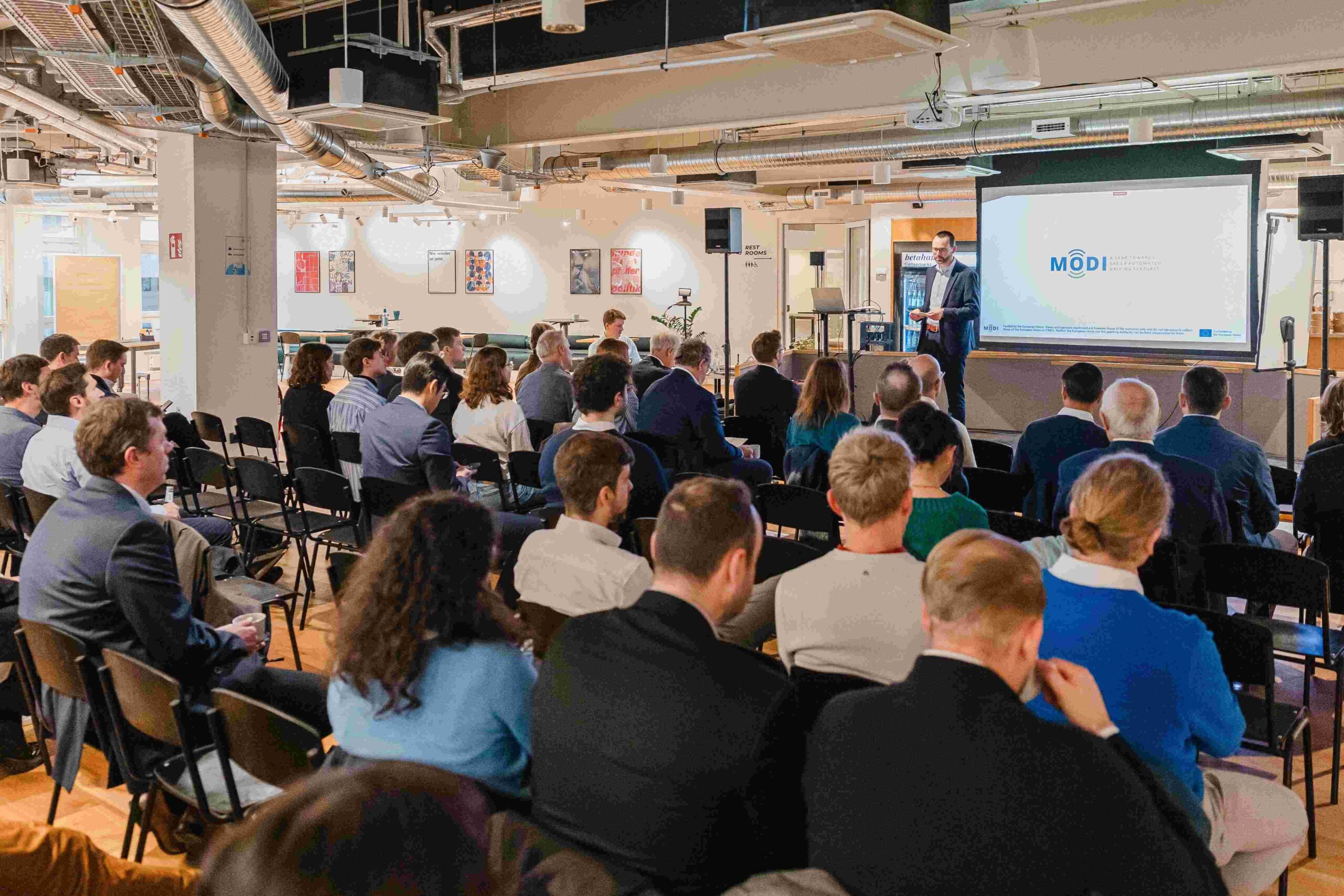
On 2–3 December 2025, stakeholders from across the logistics, mobility and innovation sectors gathered in Hamburg for the MODI Use Case Germany Public Event, hosted by New Mobility Solutions Hamburg GmbH (NMS). The event marked an important milestone for the German use case, providing participants with the opportunity to learn more about the project’s latest developments, exchange views on the future of automated freight transport, and discuss the role of Connected, Cooperative and Automated Mobility (CCAM) solutions in real logistics environments.
Hamburg plays a strategic role within MODI thanks to its position as one of Europe’s leading logistics hubs. Through the German use case, project partners have been exploring how connected, cooperative and automated mobility solutions can contribute to safer, more efficient and more sustainable freight transport operations, particularly in complex environments such as motorway access roads, urban traffic areas and port-related logistics.
The first day of the event was structured around three main blocks: Strategy & Project, Partner Presentations of the Hamburg Use Cases, and a final panel discussion on the Future of Logistics. Following the opening session by New Mobility Solutions Hamburg GmbH (NMS), participants were introduced to the European perspective on Connected, Cooperative and Automated Mobility through a presentation from the European Commission, followed by insights from the Ministry for Transport and Mobility Transition of the Free and Hanseatic City of Hamburg (BVM) on the city’s vision for future mobility and logistics.
The programme continued with an overview of the MODI project and its contribution to advancing automated freight transport across Europe, before focusing on the role of Hamburg as one of the project’s key demonstration sites. Participants gained insights into how the German use case contributes to addressing major logistics challenges such as traffic management, road safety, driver shortages, operational efficiency and sustainability.
The second block of the programme brought together several organisations directly involved in the Hamburg demonstrations. Representatives from DAF Trucks, Volvo Trucks, Gruber Logistics, the State Agency for Roads, Bridges and Waterways (LSBG) and the Federal Highway Research Institute (BASt) presented their perspectives on vehicle technologies, logistics operations, infrastructure readiness and regulatory considerations. Together, these contributions illustrated the multidisciplinary nature of CCAM deployment and the importance of cooperation across the entire transport ecosystem.
To encourage interaction and exchange, participants also took part in dedicated discussion sessions centred on the different components of the Hamburg use case. These exchanges enabled stakeholders to explore the practical challenges associated with deploying automated freight transport solutions and to discuss how vehicle manufacturers, logistics operators, infrastructure managers, public authorities and technology providers can work together to accelerate deployment.
The conference concluded with a panel discussion on the future of logistics, bringing together representatives from the European logistics innovation community, vehicle manufacturers, port authorities and other key stakeholders. Discussions focused on future deployment pathways for automated freight transport, the role of digital infrastructure and connectivity, and the actions required to support large-scale adoption of CCAM solutions across Europe.
A key message emerging throughout the event was that the successful deployment of automated freight transport is not solely a technological challenge. It also requires close collaboration between industry, infrastructure managers, policymakers, logistics operators and research organisations to create the conditions necessary for safe, efficient and scalable deployment. The German use case demonstrated how such collaboration can help bridge the gap between research, innovation and real-world implementation.
🚛 Demonstrating Automated Freight Transport in Action
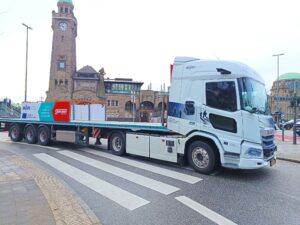
A key highlight of the event was the live demonstration of two use cases developed within the MODI project.
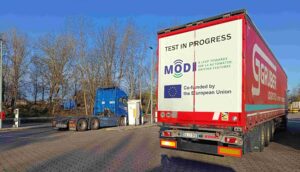
The first demonstration focused on automated motorway merging. Using a Volvo demonstration vehicle, participants observed how a highly automated truck can independently merge onto a motorway. A construction site scenario was also simulated, demonstrating how the system can safely integrate into flowing traffic under challenging road conditions.
The second demonstration showcased Intelligent Driver Assistance in Urban Areas. This use case was demonstrated using a DAF Trucks vehicle and highlighted how connectivity-enabled services can support safer and more efficient urban freight operations. Around the Landungsbrücken and Speicherstadt districts, participants experienced connected driving functions including GLOSA (Green Light Optimised Speed Advisory), protection of Vulnerable Road Users (VRUs), and automated roadworks warnings.
These demonstrations illustrated how connected and automated technologies can contribute to improving traffic safety, traffic flow and operational efficiency in urban freight transport.
🤝 Addressing Key Challenges for Logistics
Beyond the vehicle demonstrations, the event also highlighted some of the major challenges currently facing the logistics sector, including traffic management, road safety and the growing shortage of professional drivers.
Project partners presented how Cooperative Intelligent Transport Systems (C-ITS), vehicle-to-infrastructure communication and automated driving functions can support more efficient logistics operations while contributing to safer roads and more sustainable transport systems.
A crucial insight from the discussions was that the successful deployment of automated freight transport requires close collaboration between vehicle manufacturers, infrastructure managers, public authorities, logistics operators and technology providers.
🌍 Looking Ahead
The Hamburg event demonstrated how MODI is helping pave the way for the future deployment of highly automated freight transport solutions in Europe. By combining real-world demonstrations with stakeholder engagement and cross-sector collaboration, the project continues to generate valuable insights into the technological, regulatory and operational requirements needed to support large-scale deployment.
As MODI enters its final phase, the lessons learned from the German use case are contributing to a broader understanding of how connected, cooperative and automated mobility (CCAM) solutions can be successfully integrated into logistics operations. The findings generated through the project will help inform future initiatives, support evidence-based policymaking and contribute to accelerating the adoption of automated freight transport across European logistics corridors.
🎬 Don’t miss MODI promotional video on YouTube and also available on MODI’s official website.
📢 Stay tuned for further updates on our ongoing initiatives as the MODI consortium continues to expand global partnerships and drive innovation in the CCAM arena. For more information about the project and its developments, please join our Newsletter, and keep following MODI on LinkedIn and X (Twitter).